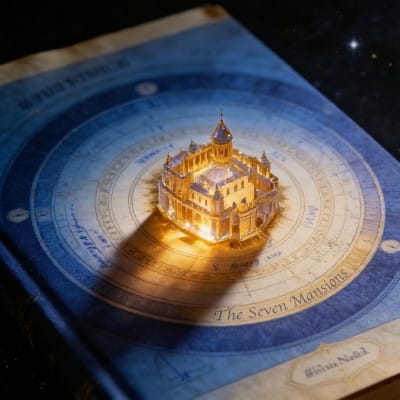
The castle is open. Leave your email at the door — all 11 episodes are waiting for you.
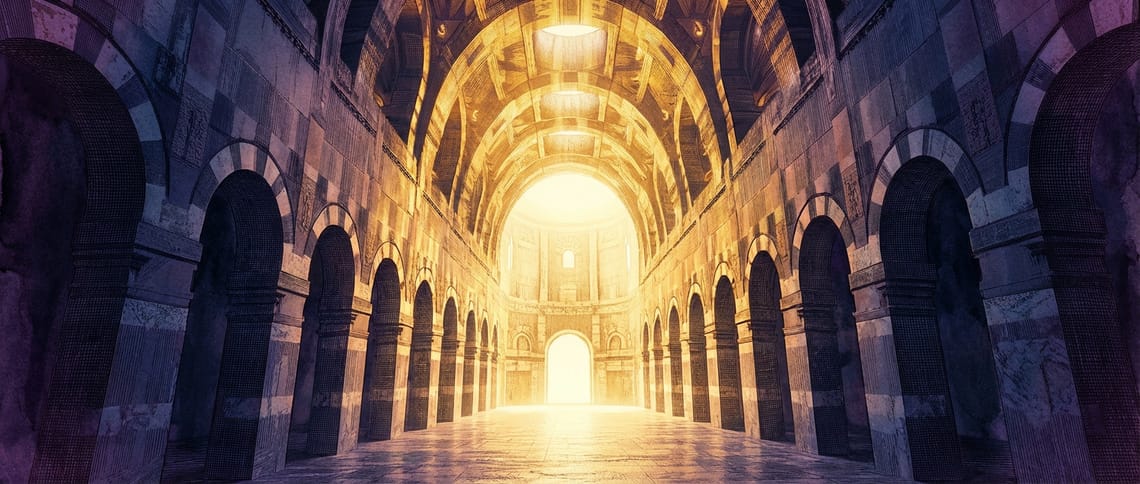
Get Free Access →Imagine a quiet room, shelves lined with warm parchment spines, where golden light spills across a lectern. This is where we meet St. Teresa—not as a distant mystic, but as a friend who's walked these seven rooms before you.
Her masterpiece on prayer, The Interior Castle, can often feel like a locked manuscript in a language you never learned. In a world drowning in spiritual content, this book is an anchor—but you need help finding the harbor. But you were never meant to read this book alone. St. Teresa wrote it as a spiritual mother talking to her daughters, assuming someone would be there to walk them through it. That's exactly what we're doing here—walking through it with you, one clear, companionable episode at a time—like a trusted friend opening a favorite book and saying, "Here, this part matters for you."
If You've Felt Intimidated, You're Not Alone
Let's be honest about what happens when you pick up The Interior Castle. You open to the first page, and St. Teresa is talking about souls as crystal castles with seven dwelling places, and there are venomous creatures in the courtyard, and suddenly you're wondering if you need a theology degree just to understand what she's saying. You power through a few more pages, but the language feels foreign, the concepts feel abstract, and after a while, you start to feel like you're the problem. "Everyone else seems to understand this," you think. "Why can't I?"
Here's what we need you to know: the problem isn't you. The problem is that this 16th-century Spanish contemplative wrote in a very specific cultural and theological context, and nobody's there to translate it for your 21st-century life. You're trying to navigate a castle without a guide, and that's not how it was meant to work.
St. Teresa herself said she was "unlearned" and didn't have "the wits" for writing this book—she only did it under obedience. She wrote like she talked: warm, digressive, full of stories and metaphors. She wasn't trying to write a theology textbook. She was trying to help her sisters understand their own souls. And that's exactly what we're here to do for you.
If you're carrying confusion, intimidation, or that stuck feeling—imagine setting it down. Imagine walking through each room with a friend who says, 'Yes, I've been here too. Here's what she means.'
This isn't just an audiobook. You can find those anywhere. This is a guided exploration—think of it as having a wise friend walk through the castle with you, pointing things out, explaining what St. Teresa really means, and showing you how it applies to your actual life.
We pause. We explain. We unpack. When St. Teresa talks about "venomous creatures," we stop and say, "Okay, she's talking about those anxious thoughts that follow you into prayer time—you know, the mental to-do list, the worry about what someone said yesterday, the guilt about not praying better." When she describes the "prayer of quiet," we don't just define it; we show you what it feels like and how to recognize it when it happens to you.
Every episode takes one section of the castle and makes it clear. We give you the context St. Teresa assumed you'd have. We translate her metaphors into modern language. And most importantly, we show you how each stage of the journey applies to your prayer life right now—whether you're a busy mom squeezing in five minutes of prayer before the kids wake up, or someone with more time who's hungry to go deeper.
Before you listen: confused, intimidated, stuck. After: clear, confident, and actually understanding what St. Teresa is saying—and what God might be saying to you.
A Companionable Guide: Walking with St. Teresa Through the Seven Mansions
Who Was St. Teresa of Avila? (Your Guide)
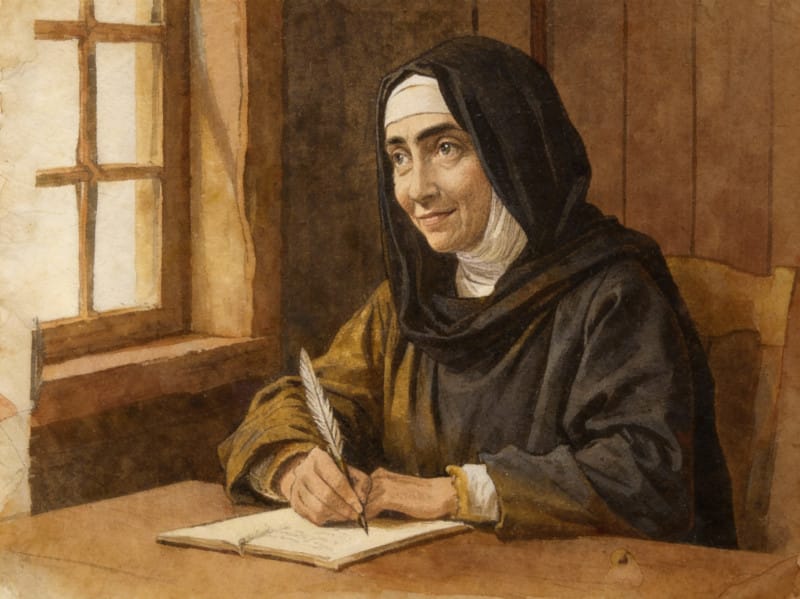
Before you trust someone to guide you through your spiritual life, you need to know they've walked the path themselves. St. Teresa wasn't always a saint. She was a charming, witty young woman who loved romance novels and good conversation. When she entered the convent at 20, she spent nearly two decades in what she calls "lukewarm" religious life—going through the motions, struggling in prayer, feeling dry and distracted. She describes watching the hourglass during prayer time, just waiting for it to end.
For twenty years, she was stuck exactly where you might be now. That's what makes her the perfect guide. She's not some distant mystic lecturing from on high. She's the friend who got lost in the same castle you're trying to navigate, finally found her way through, and then came back to draw you a map. When she writes about feeling like a failure in prayer, she's writing from experience. When she says "you're not doing it wrong," she means it—because she felt the same way for a very long time.
What is the 'Interior Castle' Metaphor? (The 'Big Idea')
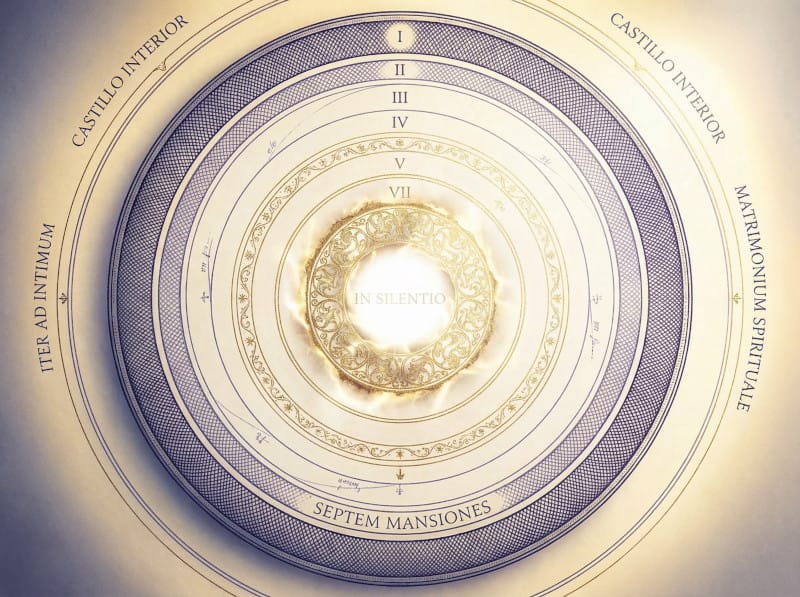
Here's St. Teresa's central insight, and it's brilliantly simple: your soul is like a castle made of crystal, with seven concentric sets of rooms. At the center, in the innermost room, God lives—dwelling in you right now. The spiritual life isn't about climbing up to reach a distant God. It's about journeying inward to discover the King who's already there, waiting for you in the throne room of your own heart.
This one image transforms everything. Instead of abstract theology about 'mystical union,' you've got a picture you can feel: you're simply walking through rooms lit by a warm golden glow, getting quieter and brighter as you move toward the center. You're not becoming someone else; you're becoming more yourself. The outer rooms are noisy and dark—that's where most of us spend our time, distracted by a thousand things. But as you move inward through prayer, the rooms get quieter, brighter, and more beautiful. You're not becoming someone different; you're becoming more yourself, more the person God created you to be.
The gate to this castle? Prayer. Not complicated, fancy prayer. Just the simple act of turning your attention away from the noise and toward the quiet presence of God within. St. Teresa wants you to know that this castle—this journey—isn't for spiritual elites. It's for you. The King "shows no partiality." He's inviting everyone inward, and all you have to do is start walking.
A Summary of the Seven Mansions (The Journey)
St. Teresa's seven mansions map beautifully onto the three traditional stages of Christian prayer. These are the Church's three traditional stages of spiritual growth—purifying our hearts, receiving God's light, and resting in His love. Understanding this framework helps you see the big picture of where you're going.
Here's a simple map of the journey. Think of it as a "you are here" guide to your own soul.
| Mansion | What Happens Here |
|---|---|
| Mansion 1: The Room of Self-Knowledge | The work here is "walking in the truth"—learning to see yourself honestly and battling the initial noise of worldly distractions. |
| Mansion 2: The Room of Perseverance | The work here is simply not giving up. You're building spiritual endurance, even when prayer feels dry, difficult, or full of discouragement. |
| Mansion 3: The Room of Ordered Virtue | The work here is moving beyond "good enough"—detaching from comfortable routines to risk deeper surrender. |
| Mansion 4: The Prayer of Quiet | This is the pivot: stop doing and learn to receive as God begins to give you the gift of peaceful, infused prayer. |
| Mansion 5: The Prayer of Union | The soul (like a silkworm spinning its cocoon) "dies" to itself and emerges transformed (like a butterfly) through a brief, profound, and unmistakable union with God. |
| Mansion 6: The Dark Night | The soul walks by pure faith through intense purification, trials, and a deep sense of God's absence to prepare for final union. |
| Mansion 7: The Spiritual Marriage | The final stage of stable, permanent union with God. The soul finds profound peace, and its purpose is perfected in selfless, loving service ("good works"). |
The First Mansions: The Room of Self-Knowledge

The Core Task: This is where you walk through the front gate. You've decided to take your prayer life seriously, to actually step away from the noise and chaos of "the world" (by which St. Teresa means anything that pulls you away from God) and turn your attention inward. But here's what St. Teresa wants you to know: when you enter this castle, you don't enter alone. You bring all your baggage with you—your anxieties, your habits, your distractions. She calls these "venomous creatures," and they're crawling all over this first room.
The Experience: It's dark in here, and it's noisy. You sit down to pray, and immediately your mind is everywhere except on God. The mental to-do list. The argument from yesterday. The worry about tomorrow. This is normal. St. Teresa says this first mansion is characterized by the battle against these distractions, against sin, against the pull of everything outside the castle walls. It's not peaceful yet. It's a battleground.
The Goal: The work here is self-knowledge—learning to see yourself honestly. Not beating yourself up, just honest truth-telling. "Yes, this is where I am. These are my struggles. This is the noise I'm dealing with." The key virtue is humility, which St. Teresa defines simply as "walking in the truth." You're learning to tell the difference between what matters and what doesn't, between the King's voice and the noise of the courtyard.
For You: If your prayer time feels distracted and dry, if you feel like you're constantly fighting just to pay attention—congratulations, you're in the First Mansions. You're not failing. You're exactly where you're supposed to be at this stage. The work here is just to keep showing up, to keep turning your attention back to God every time it wanders. Each return is an act of love.
The Second Mansions: The Room of Perseverance
The Core Task: You've been at this prayer thing for a while now. You're showing up. You've made some progress. But honestly? It still feels hard. And now you're starting to hear the voice of discouragement: "Is this worth it? Am I getting anywhere? Maybe I'm not cut out for this." This is the room where you decide whether you're going to keep walking or turn back.
The Experience: St. Teresa says the soul in the Second Mansions is like someone who can hear music playing deep inside the castle, but the noise from outside is so loud, it's hard to make out the tune. You get glimpses—moments where prayer feels real, where you sense God's presence—but then it fades, and you're back in the struggle. The devil's primary tactic here is simple: convince you to quit. He'll throw worldly pleasures in your path, make you feel like you're not making progress, whisper that this spiritual stuff isn't for "normal people like you."
The Goal: Perseverance. That's it. The victory in this room isn't feeling amazing in prayer; it's just not giving up. St. Teresa says determination matters more than consolation. You win by showing up, even when it feels like nothing's happening. The key here is finding companions—people who are on the same journey, who can encourage you when you're tempted to quit.
For You: This is where a lot of people get stuck. You've been praying for months or even years, and it still feels effortful. You're wondering if you're doing it wrong. Here's St. Teresa's message: you're not doing it wrong. This stage is about building spiritual endurance. Every time you show up to pray when you don't feel like it, you're strengthening your will. You're proving to yourself—and to God—that you're serious about this journey. Don't quit before the breakthrough comes.
The Third Mansions: The Room of Ordered Virtue
The Core Task: You've made it. You've been faithful. Your life is, by most standards, well-ordered. You go to Mass. You pray regularly. You avoid serious sin. You're a "good Catholic." And yet... there's something missing. You feel like you've plateaued. St. Teresa wrote this mansion specifically for people who feel stuck at "good enough."
The Experience: This room is comfortable. You've got your routine down. Your spiritual life is orderly, disciplined, prudent. You're doing all the right things. But if St. Teresa could sum up the danger of this mansion in one phrase, it would be: "Don't get too comfortable." She's not criticizing virtue—virtue is essential. But there's a temptation here to become so attached to your own well-ordered life, to your reputation as a "spiritual person," that you're actually protecting yourself from the deeper transformation God wants to offer you.
The Goal: The work here is detachment—specifically, detachment from your own self-image and your need for control. St. Teresa challenges the soul in the Third Mansions to ask: "Am I willing to lose it all for God? My wealth, my health, my reputation, my comfort?" Most souls in this room say, "Well, yes, hypothetically"—but they're not actually tested, so they don't know if they mean it. The invitation here is to stop playing it safe and risk going deeper.
For You: If your spiritual life feels like you're checking boxes, if you're faithful but hungry for more, you're in the Third Mansions. St. Teresa isn't saying you're doing anything wrong. She's saying you're ready for more. The transition to the next mansion requires surrender—a willingness to let God take control of your prayer life in a new way. It's scary because you can't manufacture it yourself. But that's the point. It's time to stop trying to manage your relationship with God and start receiving it.
The Fourth Mansions: The Prayer of Quiet (The Pivot)
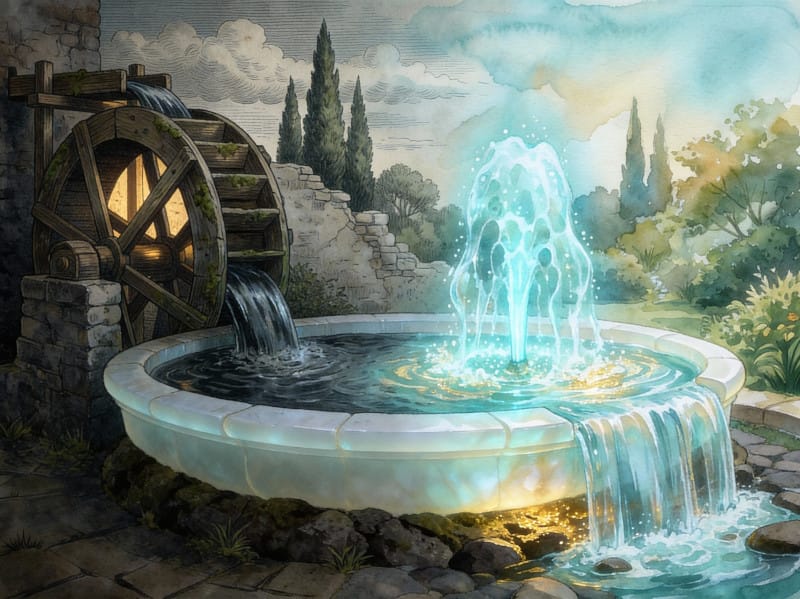
The Core Task: This is where everything changes. Up until now, your prayer has been work... Now, for the first time, God starts to take the initiative in a new way. St. Teresa calls this "supernatural prayer" (what theologians call infused prayer—when God draws your heart to Himself without your effort). It begins with a gift called the Prayer of Quiet, which is when God gives you a gentle, peaceful sense of His presence without your trying. You can't produce this yourself. You can only receive it.
The Experience: St. Teresa uses the image of two fountains to explain this shift. The first three mansions are like drawing water from a well by hand—hard work, lots of effort. But now, imagine your prayer shifting from drawing water by hand to discovering a spring bubbling up within—a warmth you didn't generate, yet recognize as gift. You're praying, and suddenly, without trying, there's a sense of peaceful presence. Your will is resting in God, just quietly enjoying being with Him, even if your mind is still wandering. It's gentle, subtle—not a dramatic experience, just a quiet awareness that something has shifted.
The Goal: The key here is learning to recognize this gift and cooperate with it. Don't try to manufacture it. Don't judge yourself when it's not there. Just notice when that peaceful stillness arises, and instead of pushing through with your own effort, gently rest in it. Let God do the work. St. Teresa warns against "spiritual gluttony"—seeking the feeling rather than seeking God. The point isn't to chase the consolation; it's to respond to the invitation.
For You: This is the room where you stop feeling like a failure in prayer. Because now you're beginning to realize: prayer isn't about what you produce; it's about what you receive. If you've ever had a moment—maybe just five seconds—where your prayer felt peaceful and you weren't trying, that was the Prayer of Quiet. It doesn't last long at first. But now you know what to look for. And you can trust that if you keep showing up, God will give these moments more and more.
The Fifth Mansions: The Prayer of Union

The Core Task: If the Fourth Mansion was God gently taking your hand, the Fifth is Him sweeping you off your feet. This is the Prayer of Union—a brief, profound moment where God unites your will completely to His, leaving a lasting mark. It's a deeper form of infused prayer where all your interior faculties (intellect, memory, will) are "suspended" and held captive by God's presence. It's brief, but it's unmistakable. And it changes you.
The Experience: St. Teresa uses the image of a silkworm to describe this transformation. The soul spins a "cocoon" through its practices and efforts in the earlier mansions. Then it enters a kind of spiritual death—everything goes still. And when it emerges, it's not a worm anymore; it's a butterfly. You can't go back to who you were. St. Teresa says the Prayer of Union leaves a certitude that God was present, a quiet conviction that can't be shaken even by doubt or dryness later.
The Goal: Surrender. Full, unreserved surrender. The soul in the Fifth Mansion is learning to die to its own will, its own agenda, its own need to understand or control. It's scary because you can't letting go of the wheel. But it's also liberating, because you're finally trusting that God knows what He's doing. St. Teresa insists this union isn't about ecstatic feelings; it's about the transformation that follows. Does your prayer make you more patient? More humble? More loving? That's the test.
For You: These graces are rare gifts, given according to God's wisdom, not our merit. But St. Teresa's point is that this is the goal—this is where God wants to bring you. Even reading about it plants a seed of desire that orients your whole journey. But if you're reading this and thinking, "I've felt something like that," pay attention. The point isn't to chase the experience; it's to let it transform how you live. The butterfly doesn't fly back into the cocoon. You're being invited to a new way of life, marked by deeper trust and freer love.
The Sixth Mansions: The Dark Night & Spiritual Betrothal
The Core Task: You'd think after the union of the Fifth Mansion, things would get easier. They don't. The Sixth Mansion is the room of intense purification. St. Teresa describes this as a "spiritual betrothal"—like an engagement before a wedding. God has proposed, and you've said yes, but the wedding hasn't happened yet. And the waiting is agonizing.
The Experience: This is where the soul experiences what St. John of the Cross (another great spiritual guide) calls the "Dark Night"—a painful but purifying time when God feels absent, which ultimately strengthens your faith. The soul receives "wounds of love," a deep, painful longing for God. St. Teresa also says this is where extraordinary mystical experiences can occur—like visions (seeing spiritual truths), locutions—an interior word from God that arrives with unmistakable clarity, like a whisper you know wasn't your own thought—or raptures—moments where prayer sweeps you up so completely that everything else falls away. But she's quick to warn: these aren't the goal, and they're also where the devil gets sneaky, counterfeiting spiritual experiences to deceive the soul. These sound extraordinary—and they are. But St. Teresa's point is that they're side effects, not the goal. The real work is becoming more humble and loving, whether you see visions or not.
The Goal: Faith and courage. This room demands both. The soul must learn to walk by pure faith when every feeling tells her God is gone. St. Teresa gives detailed teaching on discernment here—how to test the spirits, how to recognize true graces from false ones. The primary test is always the fruit: does this experience leave you more humble, peaceful, and loving? Or does it make you anxious, proud, and self-focused? And the primary protection is obedience to a wise spiritual director (a trusted guide who knows the path).
For You: This mansion can be terrifying, but St. Teresa's message is clear: if you're in this darkness, it means God is preparing you for the deepest union possible. This suffering isn't punishment; it's purification. He's burning away everything that's not love. And if you persevere, if you hold on by sheer faith when you can't feel His presence, you will come through this night into the dawn of the Seventh Mansion. Don't give up now.
The Seventh Mansions: The Spiritual Marriage

The Core Task: This is the King's chamber at the very center of the castle. The wedding day. St. Teresa calls this the Spiritual Marriage—a stable, permanent, transformative union of your soul with God (not a literal marriage, but a mystical oneness that St. Teresa uses to describe the deepest possible union with God). This is what all the previous rooms have been preparing you for. It's not a feeling that comes and goes; it's an abiding state of awareness that God is present, always, in the deepest center of your soul.
The Experience: St. Teresa struggles to describe this because it's beyond words. She says the soul is now almost continually aware of God's presence, not as an interruption to life but as the foundation of it. There's a profound peace that persists even in the midst of trials. The soul is free—free from anxious self-concern, free from the tyranny of feelings, free to love and serve without needing anything in return. The butterfly is fully transformed. Martha and Mary are working together.
The Goal: Love in action. This is St. Teresa's insistent refrain at the end of the journey: the proof of union isn't visions or ecstasies; it's "good works, good works." The soul that has reached the Seventh Mansion is marked by deep humility, patient charity, and selfless service. She's more human, not less. More present to others, not more removed. The point of all this interior transformation is to make you more like Christ—which means more capable of loving the people right in front of you.
For You: Very few souls reach this mansion in this life. St. Teresa is describing the spiritual life at its absolute peak. But here's what's important: this is where God wants to bring you. This is the goal. Not for a spiritual elite, but for you. Every single stage of the journey has been leading here, to this complete and peaceful union where you can finally rest in the truth that you are loved, you are His, and nothing can separate you from that love. That's the promise. And it's worth every step through every room of the castle.
Your Questions About The Interior Castle, Answered
Q: What is the main point of The Interior Castle?
The main point of The Interior Castle is that your soul is a place of immense beauty, like a crystal castle, and God is already dwelling in its very center. The spiritual life isn't about an exhausting climb to reach a distant God; it's an interior journey of moving inward through different "mansions" or stages of prayer. St. Teresa wrote this as a map to guide her nuns, assuring them that this path of deep, personal union with God is the goal for everyone, not just a few. You'll find a detailed summary in our guide to the seven mansions above.
Q: Is The Interior Castle hard to read?
Yes, most people find it hard—because St. Teresa assumed you'd have a guide walking with you, explaining as you go. That's exactly what we do: we're the companion she expected you to have. Our free audio exploration acts as your companion, walking you through all seven mansions, one clear chapter at a time.
Q: What are the seven mansions of the soul?
The seven mansions are seven progressive stages of prayer leading to union with God, moving from the outer courtyard of self-knowledge (Mansion 1) to the center throne room of Spiritual Marriage (Mansion 7). Think of them as rooms leading deeper into the castle. Mansions 1-3 are the "active" stages, where we do the work of self-knowledge and perseverance. Mansions 4-7 are the "passive" or "mystical" stages, where God takes the lead, granting us gifts like the Prayer of Quiet (Mansion 4), Prayer of Union (Mansion 5), a time of purification sometimes called the "Dark Night" (Mansion 6), and finally, Spiritual Marriage (Mansion 7). You can find a detailed, accessible summary of what each stage feels like in our guide to the seven mansions above.
Q: How do you read The Interior Castle as a beginner?
The best way to read The Interior Castle as a beginner is with a guide and without intimidation. Don't read it like a textbook to be "mastered"; read it as a travel guide for your own soul, one room at a time. Imagine you're standing in that quiet room with the parchment spines—just pick up the map and start with the first room. Remember St. Teresa's two pillars: Humility ("walking in the truth" of who you are and God's greatness) and Perseverance (just keep showing up to prayer, even if it's dry). Our entire free, guided exploration is designed to be the companion you need, making this classic finally click.
Q: How do the seven mansions relate to the three ways of prayer?
The seven mansions are a detailed, experiential map of the three traditional "ways" (or stages) of prayer. This theological framework helps structure the journey. The Purgative Way (Mansions 1-3) is the initial stage, focused on purification, fighting sin, and practicing virtue. The Illuminative Way (Mansions 4-5) is the stage of being enlightened by God through gifted, passive prayer, like the Prayer of Quiet. The Unitive Way (Mansions 6-7) is the final stage of deep, transformative union with God (sometimes called mystical union—when your will becomes perfectly aligned with God's will, a oneness that transcends feelings). While this framework is helpful, we focus on what St. Teresa does best: showing you what each stage actually feels like as you walk through it.
Q: Am I 'doing prayer wrong' if I don't experience these higher mansions?
Not at all. If you're in Mansions 1-4 and feeling dry? You're not behind. You're building the foundation St. Teresa herself needed for twenty years. St. Teresa is describing the full journey God might give, not what you must achieve. Most of us spend our lives in Mansions 1-4, and that's exactly where God wants us. The goal isn't to 'level up'—it's to love God and neighbor wherever you are.
Q: Do I need to be Catholic to read The Interior Castle?
No, you don't need to be Catholic to benefit from The Interior Castle. While St. Teresa was a Catholic nun writing in the 16th century, her insights into prayer, self-knowledge, and the soul's longing for God transcend denominational boundaries. Many Protestants and Christians from various traditions have found her map of the spiritual journey deeply valuable. Our guide focuses on these universal themes—how to pray, how to recognize God's voice, how to navigate spiritual dryness—making it accessible for any Christian seeking a deeper relationship with God. There are a few Catholic-specific references (like the sacraments and religious life), but we explain these in context so they enrich rather than confuse the journey.
You Were Never Meant to Read This Alone
Look, we know you're busy. We know your spiritual life already feels like one more thing on an impossible to-do list in a world that never stops talking about spiritual growth. This isn't about adding to your plate. It's about making sense of what God is already doing—those moments in prayer when you sense there's something more, but you can't quite name it. St. Teresa named it. And now, so can you. We're just picking up where she left off, walking through that map with you, one room at a time.
This entire guided exploration—all eleven episodes—is a gift to you. We believe this book can change your life, and we don't want cost to be the barrier that keeps you from experiencing it. So stop feeling intimidated by The Interior Castle. Start understanding it today. Your soul is a castle, and the King is waiting for you inside.
Enter the Castle: Start Episode 1
P.S. This complete 11-episode program is our free gift to you. When you're ready, you'll find more guided journeys waiting—each crafted with the same care, each an invitation deeper into the library.
Explore the Library
More guided explorations of the spiritual classics